I'm here at Menucha, a Presbyterian retreat, for my IGERT week-long retreat. Just got introduced to the second cohort. Like the first-year cohort that I've spend the lion's share of my time with this group is filled with folks with a lot of experience and educational backgrounds. Some truly heavy hitters are here and that's inspiring from an academic point of view, but also for the program, as a whole. It means that Portland State is getting around and this program has the ability to pull in competitive folks.
Unsurprisingly, most of the day was dedicated to introduction and a three-hour session talking about team building and dynamics. It was marginally useful, good to hear some stuff, but, you know, it's still a three hour session on team building. Although, there were no trust falls or rope course type stuff...so...little blessings. Although, there was a bit of a dustup when our lecturer started to discuss the pitfalls of putting major decisions to a vote and gave us advice on what topics are appropriate for votes (trivial things with relatively few options, btw). Doug, one of the cohort, asked what an alternative decisionmaking process would be and our lecturer didn't really give an adequate answer. At least not one I could understand. It was basically a call for some kind of general consensus that occurs when your group has talked all possible options to death and you end up going with something either out of exhaustion, time restraints, or individual stubbornness. Which is, of course, what happens when you depend on consensus based decision tools. You have all of the risks of deliberative democratic techniques that have plagued communicative and democratic theorists for years.
I mentioned how this was kind of a basic weakness in the approach and the issue, appropriately, was unresolved and we left with a consensus. A real teachable moment, actually. At least from a planning theoretical perspective.
So...reflections from first day thus far...everyone should be required to read more planning theory. And can we finally bury communicative planning?
As always, keep it surly. Til tomorrow.
Monday, September 10, 2012


Friday, September 7, 2012
Dissertation/project thoughts/musings
I'm back in sunny Portland, OR and getting ready to start year 2 of this phd. So, like any diligent grad student I am already behind on work and projects. Instead of working on those, though, I'm going to follow in the grand tradition of phd students everywhere and think about other projects!! As always, comment as you will...could use the feedback.
Ecosystem Services and Econ Dev
My current obsession is thinking about sustainable urban development, ecosystem services, and economic development. Big, I know, but bear with me. Specifically, I'm trying to think about ways one can link ecosystem services or ecologically-centered development approaches with economic development...specifically, I'm thinking about attacking water quality issues through urban greening projects. There is a growing body of work trying to better tie ecological indicators and values into input-output analysis to assist in better calculating the economic impacts of our natural capital. I haven't read deeply into this work yet, but the Europeans seem to be diving into it. It would be interesting to see if I could adopt some of that work and apply it on a city or regional scale and combine it with economic development planning.
There's a lot here that needs to be fleshed out in terms of theory, methods, finding an appropriate case...but we could potentially expand the scope of economic development planning and environmental planning by adding in ecological benefits to induced economic impacts. Also, a recent paper in Marine Policy by Edwards et al performs an economic impact analysis of coastal restoration projects using ARRA (Obama Stimulus) money and found that for every million dollars invested in "blue infrastructure" 17 direct jobs were produced. This did not include indirect and induced jobs nor did it include long term benefits of such restoration like improved fisheries for commercial fishing, tourism, or water filtration.
The point is that in terms of infrastructure spending, blue infrastructure spending seems to be incredibly effective compared to other infrastructure projects that also have direct job counts like mass transit, road repair, or gas pipeline construction.There is definitely something here in terms of positive real economic development impacts in investing in our environment. What are some ways that this could apply in economic development and urban development strategies? This is what I'm musing on, currently.
Leave some comments if you have any thoughts, observations or what have you.
And in honor of @tnopper (a great follow, btw) I'm gonna try out a tagline for my posts now...so, without further delay, here it is-- Keep it surly. I'm out.
Ecosystem Services and Econ Dev
My current obsession is thinking about sustainable urban development, ecosystem services, and economic development. Big, I know, but bear with me. Specifically, I'm trying to think about ways one can link ecosystem services or ecologically-centered development approaches with economic development...specifically, I'm thinking about attacking water quality issues through urban greening projects. There is a growing body of work trying to better tie ecological indicators and values into input-output analysis to assist in better calculating the economic impacts of our natural capital. I haven't read deeply into this work yet, but the Europeans seem to be diving into it. It would be interesting to see if I could adopt some of that work and apply it on a city or regional scale and combine it with economic development planning.
There's a lot here that needs to be fleshed out in terms of theory, methods, finding an appropriate case...but we could potentially expand the scope of economic development planning and environmental planning by adding in ecological benefits to induced economic impacts. Also, a recent paper in Marine Policy by Edwards et al performs an economic impact analysis of coastal restoration projects using ARRA (Obama Stimulus) money and found that for every million dollars invested in "blue infrastructure" 17 direct jobs were produced. This did not include indirect and induced jobs nor did it include long term benefits of such restoration like improved fisheries for commercial fishing, tourism, or water filtration.
The point is that in terms of infrastructure spending, blue infrastructure spending seems to be incredibly effective compared to other infrastructure projects that also have direct job counts like mass transit, road repair, or gas pipeline construction.There is definitely something here in terms of positive real economic development impacts in investing in our environment. What are some ways that this could apply in economic development and urban development strategies? This is what I'm musing on, currently.
Leave some comments if you have any thoughts, observations or what have you.
And in honor of @tnopper (a great follow, btw) I'm gonna try out a tagline for my posts now...so, without further delay, here it is-- Keep it surly. I'm out.
Tuesday, August 14, 2012
ESP and ESA Reflections
The past two weeks have been incredibly busy up here. I presented a poster at the Ecosystem Services Partnership fifth annual conference and at the Ecological Society of America's annual conference. It has been an exhausting, yet enlightening, two weeks. While this isn't an exhaustive review there are a couple of observations I want to put down. I meant to do this as the conferences were ongoing but I get distracted. Forgive the bullet points, this is pretty quick and dirty:
- Ecosystem services will be THE preferred environmental policy tool of our generation- while ESP was a smaller conference, there were heavy reps from the World Bank, UN, academia, and some large NGOs like Conservation International. In other words, powerful people and institutions have fully invested in the idea and application of ecosystem services. At ESA, there were very few talks that were geared towards policy or intervention that did not mention "ecosystem services" at least once.
- Ecosystem services are still heavily debated and not well understood- the basic concept of ecosystem services, the benefits that humans accrue from their environment is an intuitive idea. The trickiness comes from trying to apply this idea in a policy setting and the insistence on economic valuation. There are a variety of issues here...
- Issues of Valuation: this is the single biggest set of issues that both opponents and adherents to ecosystem services constantly bicker over. Beyond the foundational debate of whether or not it is appropriate to economically value and commodify the multiple benefits we accrue from our environment, there are serious issues involving the accounting for these benefits. Questions regarding double counting when taking regulating and supporting services into account are paramount as well as the appropriateness of different valuation methods. These are incredibly important issues for policymakers and there are a lot of good researchers looking into it. Still...it's troubling that we continue to push these programs even with these doubts and reservations regarding valuation.
- Commodifying Nature: If we take valuation as legitimate and possible, then we must also examine the degree to which we want to expose ecosystem services to commodification. There's a HUGE difference in attempting to calculate the benefits received from our environments and using those values to better inform decision making as opposed to setting values on these services for the purpose of putting them onto the international market like carbon credits in the REDD scheme. While nearly all of the speakers at ESP, including Bob Costanza, said that ecosystem service schemes were not put in place for such explicit commodification, the existence of programs like REDD and other schemes to trade credits of varied sorts shows the risks in placing explicit dollar values on goods and processes that were once not commodified. No one at ESA, from what I saw, was talking about this, but this is a going to be one of the biggest fights within the field over the next few years.
- More mainstream ecologists need to enter this conversation: while many people mentioned "ecosystem services" in their talks at ESA, it was unclear to me if folks had a solid understanding of some of the deeper issues involved. Yes, we can mention the multitude of ecosystem services we gain from our surrounding ecosystems, but we must be careful at throwing around the term ecosystem services in every presentation. This is an idea which is becoming increasingly specified and it borders on the irresponsible to not be better acquainted with how policymakers and other scientists are using the term. That being said, we need more ecologists to come in and speak forcefully on the issues mentioned above and to claim or re-claim this idea of ecosystem services in order to guarantee that we can better understand the ecological processes that make up ecosystem services and to be forceful advocates to warn against the excesses of commodification. But this requires a lot more outreach on ecologists and to insert themselves into the conversation.
- Ecologists want interdisciplinary work: This was a constant, positive takeaway from these two weeks. Ecologists are taking the idea of socioecological systems very seriously and want to do more work that takes the social side of ecological questions seriously, especially in urban areas. There was a constant refrain from people I met of,"Humans are part of ecology!" So, the idea of ecosystem services, of linking the social and political with the ecological is hot right now. For my urbanists, planners, and other social scientists, if you're interested in working on environmental and ecological issues there has probably never been a more fruitful time to pursue these goals. This is, overall, the most positive aspect of this meeting to me. Even classical ecologists are coming around to this idea that studying humans is incredibly important when dealing with ecology.
There's a lot more to be said but those were my major takeaways from these two weeks. I hope to add a bit more to it later on.
Friday, July 13, 2012
Guest Post: ACA Ruling Effects on Labor
It's a special day at Surly Urbanism as we have our first official guest post from my man, Steve ( steven.howland@gmail.com). He's a classmate of mine and specializes on issues in economic development and regional science. Show him some love. And, as always, hit up the comments. Without further ado...
Some labor market considerations from the ACA decision
The original purpose of the act was to insure all Americans. This was due to the large number of uninsured in the U.S. (nearly 50 million in 2010 according to the Census Bureau) creating a large amount of non-coverage charges and in effect passing those costs on to insured consumers. Aside from collective cost issues, insurance for all is important for labor concerns as well. Gallup has been tracking the number of uninsured in the U.S. through their well-being index and found that since 2008, the percentage of adults 18 and older without health insurance has increased from 14.8% to 17.1% in 2011. Much of that increase can be attributed to the disastrous jobs situation in the U.S. since 2007, but we cannot be assured that the rate will decrease as jobs come back. That is evident in a more recent Gallup poll which has been tracking employer-sponsored insurance (ESI) by age group from 2008 to mid-2012. Even though jobs have been added to the economy every month since late 2010 (see BLS report here), the percentage of the population that has ESI coverage has continued to drop substantially. From 2008 to 2010, the best employed age group (26-64 year olds) saw a 3.5% decrease in employer coverage, and it dropped another 2.2% under increasing employment conditions. While it is very likely the continued decrease in employer provided insurance is due to cost cutting by employers to cope with the economy and the lack of bargaining power that labor unions have to keep the benefits, there are no widespread surveys to truly understand what is happening.
Chart 1: Insurance Status by Family Income for Non-Elderly, Full-time/full-year workers excluding self-employed, 2005-06#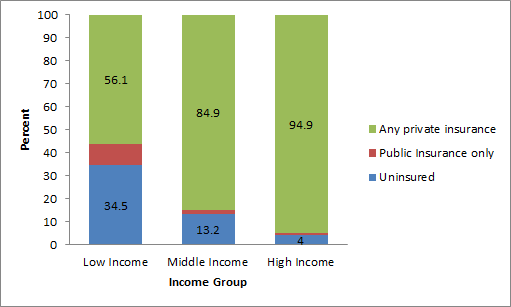
Chart 2: Population of Low-income Workers by Employment Status, in Millions: 1996-97 to 2005-061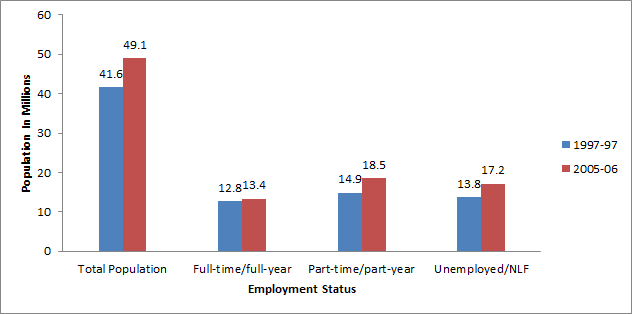
Some labor market considerations from the ACA decision
It’s been two weeks since we have all learned of the constitutionality of the Affordable Care Act (ACA). Since the announcement, Republicans have been roiling over the ruling while ramping up efforts to repeal the act in its entirety (the House just held their 31st vote of this Congress to repeal the act). Democrats, meanwhile, have been largely ready to move on from the discussion and on to “greater” issues in the national policy spectrum. What has been largely missing from any of the national media attention around the ACA has been the effect the Supreme Court decision will have on labor. While the individual mandate was found constitutional under Congressional tax powers, the Supreme Court also determined that the states cannot be penalized for failing to expand their Medicaid programs to cover everyone up to 133% of the poverty level as envisioned under the law. Both rulings will have significant effects on many different groups of workers. The first of which is how employers will respond to the necessity of insurance coverage or facing a tax. The second and equally if not more troubling effect is the implication for those falling in what I am terming the insurance gap.
The original purpose of the act was to insure all Americans. This was due to the large number of uninsured in the U.S. (nearly 50 million in 2010 according to the Census Bureau) creating a large amount of non-coverage charges and in effect passing those costs on to insured consumers. Aside from collective cost issues, insurance for all is important for labor concerns as well. Gallup has been tracking the number of uninsured in the U.S. through their well-being index and found that since 2008, the percentage of adults 18 and older without health insurance has increased from 14.8% to 17.1% in 2011. Much of that increase can be attributed to the disastrous jobs situation in the U.S. since 2007, but we cannot be assured that the rate will decrease as jobs come back. That is evident in a more recent Gallup poll which has been tracking employer-sponsored insurance (ESI) by age group from 2008 to mid-2012. Even though jobs have been added to the economy every month since late 2010 (see BLS report here), the percentage of the population that has ESI coverage has continued to drop substantially. From 2008 to 2010, the best employed age group (26-64 year olds) saw a 3.5% decrease in employer coverage, and it dropped another 2.2% under increasing employment conditions. While it is very likely the continued decrease in employer provided insurance is due to cost cutting by employers to cope with the economy and the lack of bargaining power that labor unions have to keep the benefits, there are no widespread surveys to truly understand what is happening.
The ACA is meant to remedy the loss of ESI to some extent in 2014 by implementing taxes on employers not providing insurance and tax incentives for individuals and families making under 400% of the poverty level. By taxing ($167/month per full time employee in excess of 30 with increasing penalties over time) employers with the equivalent of 50 or more full-time employees if any of their employees are not covered by an employer-sponsored health plan, the ACA is expecting employers to take a high road approach and maintain or add health insurance plans for their employees. The fault in that expectation is that those taxes rest far below the cost of actually insuring their employees and is likely to lead many employers, especially those with fewer than 100 employees to opt out of paying for insurance if they are not already doing so. Companies that are currently offering insurance to their employees may reevaluate whether or not to continue insurance coverage for their employees. This is due to the tax incentives that are available to workers earning between 133% and 400% of the poverty level. Several options are available to employers to comply with the law, and one such option is to give their employees a free choice voucher in order to purchase their own insurance in an insurance exchange. A McKinsey Quarterly report from from a survey they conducted last year found that when employers give their employees a voucher to purchase their own plans, 70% of employees chose a less expensive plan than the employer was going to offer, thus saving the company money. However, that may not provide the kind of coverage an employee needs or desires.
For those left to purchase insurance on their own, the tax credits available to individuals and families earning under 400% of the poverty level could affect their willingness to pressure their employer for another option. Under the incentive rules, those at 400% of the poverty line will see their health care expenses capped at 9.5% of their income. That means a family earning $80,000 a year could be responsible for up to $7600/year in health costs or $633/month and anything above that would be covered by tax incentives. The incentives may be insignificant enough that a backlash could ensue. With the amount of debt the American public has accrued, asking people to contribute nearly 10% of their income to health insurance may be a burden they will be unable to cover. Luckily, there are hardship exemptions, but how lenient the IRS will be with those is a large grey area at this point. The concern for those at the tail end of the tax incentive income bracket is likely to be blunted substantially due to the fact that higher incomes usually mean employers act more competitively with those employees and will be more likely to offer health benefits to do so. As such, those left without ESI at the tail end of the bracket will likely have fewer collective voices to bring attention to the cost burden problem. The larger concern out of this is that without the Medicaid expansion in all states, there will be millions of low-income workers that will be severely harmed by the ACA.
At the lower end of the economic ladder poor and low-income workers were to see large benefits come to them from the ACA. The Supreme Court ruling put some of that in jeopardy. Without being able to penalize states that do not agree to expand Medicaid rolls to include everyone up to 133% of the poverty level, millions of workers are likely to see large health care bills in their future. Seven Republican governors have pledged to not expand Medicaid and many more can be expected to opt out considering their involvement in the lawsuit against the Federal government over the ACA (see map below or a larger version here). Health and Human Services Secretary Kathleen Sebelius sent a letter to the states on July 11 saying that should they opt out of the Medicaid expansion, their low-income population will be eligible for hardship waivers. That’s a relief for low-income workers, but it also means they will fall into the insurance gap by being the only substantial group, except for undocumented immigrants, that will remain uninsured. At the very least, it appears that states can still be penalized with the loss of all Medicaid funding if they restrict access to Medicaid any further, providing they do not file for a exemption due to budgetary constraints. The insurance problem for low-income workers is only further complicated by looking at where low-income workers are employed and how that impacts their insurance status.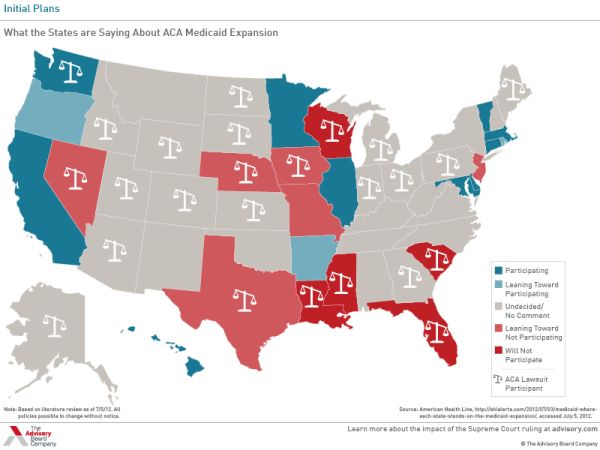
Low-income workers are rarely provided ESI for the primary reason that a large majority of them are part-time employees. A 2009 report from the Medical Expenditure Panel Survey showed that between 1996-97 and 2005-06 even full-time low-income workers have been left out of ESI coverage (See Chart 1 recreated from the report). With the growing number of low-income workers and part-time employment, the situation becomes more dire. Nearly half the 7.5 million worker growth of low-income workers in the U.S. was in part-time employment (3.6 million) while most the other half was growth in unemployment (See Chart 2 recreated from the MEPS report).
Chart 1: Insurance Status by Family Income for Non-Elderly, Full-time/full-year workers excluding self-employed, 2005-06#
Chart 2: Population of Low-income Workers by Employment Status, in Millions: 1996-97 to 2005-061
If it is expected that low-income workers are to be helped out by the employer requirements of the law, that expectation is likely to fall short. Part-time employees are not covered under the employer mandate portion of the ACA, but large employers will be penalized for employing a part-time employee that has claimed a premium credit for insurance from a state insurance exchange. This could make large employers more selective about who they hire and may lead employers to re-evaluate the costs and benefits of having part-time vs. full-time employees. Should employers find the costs pan out to have more full-time employees, that will be good for a select few workers, but many others will go unemployed as a result. Business size will also factor into the situation considerably. According to the MEPS report, in 2005-06 nearly 70% of full-time non-elderly low-income workers were employed in establishments with fewer than 100 employees. Over 45% of those were working in establishments with fewer than 25 employees. Since the ACA only mandates that employers with 50 or more employees participate, the growth in ESI coverage is likely to be minimal for low-income workers. While tax credits will be available to small-businesses (those with fewer than 25 employees) to provide or maintain health benefits for their employees, it is not likely that the small businesses in which a majority of low-income workers are employed will be providing any additional health coverage than they already are. Even then, the tax credits only last for 2 years.
What will be left is a fairly significant portion of the population that will still be uninsured. These will be households that already are struggling from high costs of housing and transportation in most metropolitan areas. Low-income workers that fall into the insurance gap between qualifying for Medicaid and without ESI will face a problematic labor market status. Their lower income competition will have health care provided to them so that they can stay healthier and thus more productive. Since they provide a lower labor cost to the employer, their usefulness to the employer will put them at a labor market advantage over just slightly higher income workers. Meanwhile, by not having insurance, the low-income workers that fall into the gap can see their health falter leaving them at a disadvantage over other workers of similar income that were able to get insurance through their employer. Not only can their health put them at a disadvantage, any medical emergencies could easily put them in severe debt and limit their employment opportunities as more employers are checking credit scores for potential employees.
Ultimately, many millions of workers will be aided by the ACA as it is implemented over the next few years even with problems to fix for those in the insurance gap and the large amount of pure speculation in how employers will decide to act. Employers that already offer insurance are likely to continue offering insurance in the future, but if they employ a large proportion of low-income workers, they may find it better to offer vouchers instead. Should this law actually transition employers into hiring more full-time employees, we could see a climb in unemployment. One thing that is not likely is that the tax penalties or insurance premium costs will substantially dent hiring, especially among employers at or near the 50 employee mark as many conservatives have claimed. The reason for this is that the tax penalties will not be substantial enough to offset the profit growth obtained by expanding employment and, in effect, output. Also, Factcheck.org checked the GOP claims that the law will kill jobs, and their analysis found only the Congressional Budget Office and The Lewin Group had provided non-partisan analyses on the job effects of the law as of January 2011. Both said the job losses would be small with most the losses made up by gains in the healthcare industry. The Lewin Group expects some employers to turn to more part-time employment, but I still suspect that employers would be more likely to turn to vouchers for all employees or more full-time employment over the risk of employing a part-time worker that could trigger tax penalties far in excess of the cost of the part-time worker. For employers that choose to accept the tax penalties, it would be possible to employ part-time employees with no risk. In the end, the complications and inefficiencies brought about by this law and the subsequent Supreme Court ruling will make many wish we had a single-payer system instead. But, since this is what we were given, it is the system we will have to work with for the foreseeable future.
Thursday, June 28, 2012
Ignored Prophets: Why no Black urbanists?
A recent blog post is making the rounds of the twitter-sphere and causing a little bit of a buzz. The post asks the provocative question: where are the Black urbanists?
When I first read this piece I must admit that I nodded right along and found it a bit refreshing. But upon further reflection, and discussion with @rjkoscielniak and @tressiemcphd over email and beers, I became increasingly discontent and have decided that I disagree with the premise of the piece for a few reasons. There are black urbanists. We've simply been ignored or excluded. In other words, it's not community activist recalcitrance, white flight, or even large cultural perceptions of urban=bad/dirty that have limited the voices of Black urbanists, but widespread structural and cultural racism, and an urbanist community that is largely silent on issues that many Black urbanists, activists, and scholars have advocated over the life of this country.
Where art thou, urbanist?
But first let's examine what it is we mean by "urbanist". Pete Saunders actually gives the reader a couple of definitions that are slightly contradictory. Not in a way that totally invalidates his points, but it goes to the difficulty of trying to define who can be classified as an "urbanist" and the inclusion or exclusion of Black voices. The first distinction is in delineating "traditional" urbanist areas of concentration: academics and intellectuals concerned about urban form characterized by abstraction and design-centered approaches. The second includes issue advocates such as urban agriculture activists, transit proponents, walkability folks etc. These two distinctions are narrow and fairly specific (one could challenge them, but I applaud trying to better bracket what we mean by "urbanist"), but Saunders then shoots himself in the foot by referencing the Planetizen Top 100 Urban Thinkers that includes multiple activists, scholars, politicians that don't fit those two prior areas, unless he wants to expand his notion of activists a lot wider. Jacob Riis, Henry Ford, and Prince Charles are all included on the list and do not fit the narrow definitions first offered.
To his credit, Saunders fully recognizes that the fields of urban planning, architecture and other design-centered industries have very low minority representation, thus limiting the potential range of prominent black voices from those fields. So, already, we need to recognize past structural barriers to entry to Black voices and contemporary structural issues that potentially limit the ability of Blacks to be heard. But that does not explain the total indifference to prominent Black commentators on urban life and urbanism in other fields, including planning.
Some Black Urbanists
First, let's see if we can find some Black urbanists that would fit Saunders' more traditional definitions and see if we can recognize these people as respected and influential thinkers. The two people that instantly jumped out in conversation with folks were Professors June Manning Thomas and William Julius Wilson.
Professor Thomas has authored or edited multiple books examining issues of social equity, racial justice and urban development. There are few active Black planning scholars today that compare to her notoriety and expertise and there are very few scholars at all in planning that examine issues of race, re-development, decline and urban history like Dr. Thomas.
Professor William Julius Wilson probably needs very little introduction to most of the readers of this blog, but it is not an exaggeration to say that he re-defined our concept of poverty, the ghetto, and work. There are few more eloquent critics of urban development and its role in exacerbating existing social and racial disparity.
We can argue over scoring points in identifying Black urbanists but when you talk about intellectual concepts of space as well as strong advocates, then I would say you would be hard pressed to find two scholars more esteemed than Thomas and Wilson. Yet these two are nowhere to be found in the post or Planetizen's list.
But extending our concept of urbanist to a broader range of individuals, like those found on Planetizen's list yields an even richer amount of Black urban voices. Some of these folks are no longer with us while some are. The point is to show that we have a MULTITUDE of Black urbanist voices that are not commonly accepted or cited (I'll try to give some theories as to why they're so ignored further on).
When I first read this piece I must admit that I nodded right along and found it a bit refreshing. But upon further reflection, and discussion with @rjkoscielniak and @tressiemcphd over email and beers, I became increasingly discontent and have decided that I disagree with the premise of the piece for a few reasons. There are black urbanists. We've simply been ignored or excluded. In other words, it's not community activist recalcitrance, white flight, or even large cultural perceptions of urban=bad/dirty that have limited the voices of Black urbanists, but widespread structural and cultural racism, and an urbanist community that is largely silent on issues that many Black urbanists, activists, and scholars have advocated over the life of this country.
Where art thou, urbanist?
But first let's examine what it is we mean by "urbanist". Pete Saunders actually gives the reader a couple of definitions that are slightly contradictory. Not in a way that totally invalidates his points, but it goes to the difficulty of trying to define who can be classified as an "urbanist" and the inclusion or exclusion of Black voices. The first distinction is in delineating "traditional" urbanist areas of concentration: academics and intellectuals concerned about urban form characterized by abstraction and design-centered approaches. The second includes issue advocates such as urban agriculture activists, transit proponents, walkability folks etc. These two distinctions are narrow and fairly specific (one could challenge them, but I applaud trying to better bracket what we mean by "urbanist"), but Saunders then shoots himself in the foot by referencing the Planetizen Top 100 Urban Thinkers that includes multiple activists, scholars, politicians that don't fit those two prior areas, unless he wants to expand his notion of activists a lot wider. Jacob Riis, Henry Ford, and Prince Charles are all included on the list and do not fit the narrow definitions first offered.
To his credit, Saunders fully recognizes that the fields of urban planning, architecture and other design-centered industries have very low minority representation, thus limiting the potential range of prominent black voices from those fields. So, already, we need to recognize past structural barriers to entry to Black voices and contemporary structural issues that potentially limit the ability of Blacks to be heard. But that does not explain the total indifference to prominent Black commentators on urban life and urbanism in other fields, including planning.
Some Black Urbanists
First, let's see if we can find some Black urbanists that would fit Saunders' more traditional definitions and see if we can recognize these people as respected and influential thinkers. The two people that instantly jumped out in conversation with folks were Professors June Manning Thomas and William Julius Wilson.
Professor Thomas has authored or edited multiple books examining issues of social equity, racial justice and urban development. There are few active Black planning scholars today that compare to her notoriety and expertise and there are very few scholars at all in planning that examine issues of race, re-development, decline and urban history like Dr. Thomas.
Professor William Julius Wilson probably needs very little introduction to most of the readers of this blog, but it is not an exaggeration to say that he re-defined our concept of poverty, the ghetto, and work. There are few more eloquent critics of urban development and its role in exacerbating existing social and racial disparity.
We can argue over scoring points in identifying Black urbanists but when you talk about intellectual concepts of space as well as strong advocates, then I would say you would be hard pressed to find two scholars more esteemed than Thomas and Wilson. Yet these two are nowhere to be found in the post or Planetizen's list.
But extending our concept of urbanist to a broader range of individuals, like those found on Planetizen's list yields an even richer amount of Black urban voices. Some of these folks are no longer with us while some are. The point is to show that we have a MULTITUDE of Black urbanist voices that are not commonly accepted or cited (I'll try to give some theories as to why they're so ignored further on).
- W.E.B. DuBois- other than being one of the most eloquent critics of American racism and a prolific scholar, DuBois' The Philadelphia Negro: A Social Story is a landmark bit of urban sociology and geography as well as a great exploration of the socio-spatial relations of segregation in a northern city. A true urbanism project.
- Elijah Anderson- noted sociologist and urban ethnographer that has also helped to redefine our perceptions of the "street" and the people who live there. A strong voice for marginalized and ghettoized populations and a great Black urbanist scholar.
- James Baldwin- a great writer and critic of American racism, Baldwin also wrote extensively about growing up in Harlem and the unique rhythms, circumstances, the simultaneous expressions of hope despair, love and hate, suffering and salvation that define the lives of poor Black people
- Langston Hughes- few people have better illustrated the lives of Black people in verse and his portraits of Black life in the city resonate still
- Martin Luther King Jr.- seriously, if we include Jacob Riis on the Planetizen list, then you gotta have Dr. King. The civil rights movement in many ways was an urban movement and few people spoke as eloquently on the hope of this country and its cities and their abilities to accept Black people fully than King.
- Malcolm X- A product of our cities and our prisons. Malcolm X, and the Nation of Islam, were urban-based activists and their demands for self-determination, self-defense and community economic development are rich, deep models of alternative urban life.
- Franz Fanon- while not an American Black person his anti-colonial works were once again based largely in cities and from observation of the city lives of marginalized and colonized peoples.
- Huey Newton, Bobby Seale and the Black Panther Party- an urban revolutionary organization that demonstrated the power of local political action and the possibilities of different ways of organizing our own lives and society in a way that was more inclusive. The party stands as a great example of a radical urbanism that is often ignored by many urbanist and planning scholars.
- Majora Carter- while Carter is still relatively new on the scene her advocacy for environmental justice, livability, and equality stands as a strong guide for urbanists that are legitimately interested in sustainability and the city. Not that one should care but she has a national TED talk. I mean, c'mon, do you need a bigger sign in our new world of one's importance?
This list could go on and on. I also recognize that the list is incredibly light on women, queer folk of color and many other groups. While I cannot provide an exhaustive list, I wanted to try and balance names that many people should be familiar with and show that there are a variety of Black urbanist voices but they are not recognized within the urbanism community.
Can we get some love?
Why aren't these folks recognized as visionary urban or urbanist thinkers? I have two ideas why.
The first, as Saunders accurately pointed out, is that Black folks are not heavily represented in the "traditional" urbanism fields. Architecture, as a profession, has a long history of trying to improve its diversity. We find similar disparity in many design-oriented fields when we examine minority and woman representation. Until we can better prepare Black students to enter these fields as well as reform these fields to better value racial and gender diversity, then this disparity will persist.
The second reason is a bit more subtle, but it has to do with the politics of these commentators. If you examine some of the celebrated urbanists that Saunders cites by name and the Planetizen list, then it becomes evident after a while that the politics of many contemporary urban thinkers rests squarely within the status quo or actually veers a bit to the right. Thinkers like Flordia, Duany, or a Kunstler have not been strong advocates of racial or social justice. While their work may seem radical in that it questions some closely-held cultural beliefs over car ownership, sprawl etc their views that do not really actively trouble existing social, political, or economic relations. In fact, it is quite telling that when you examine the Planetizen list that the openly radical, American thinkers all were practicing or directly influential more than 30 years ago. The closest we get is Norm Krumholz and equity planning, but we can't pretend that this is a dominant urban development paradigm. In fact, when we look at contemporary big-time thinkers, we often find that they say very little on issues of racial equity, social justice, environmental justice, poverty alleviation etc...areas of concern that traditionally have been areas where Black academics have focused.
It is this cordoning off of acceptable areas of urban inquiry that is a major blow to the notoriety of Black urbanists. It is telling that Saunders, when listing urban "advocates" as part of his urbanist dualism, does not mention housing affordability advocates, transit justice advocates, or environmental justice groups as urbanist interest groups. Organizations like PolicyLink, headed by Angela Glover Blackwell, is a national thought leader and strong advocate for urbanism based on equity and access for people of color and the poor, yet organizations like PolicyLink and thinkers like Blackwell are not included as urbanism advocates? Why? Because their concepts of urbanism and the city explicitly challenge the awful social relations, based in racism, segregation, and neoliberal development, that dictate much of urban life for marginalized folks of all races and creeds. Asking for more bike lanes and transit oriented development, while different and "progressive", aren't necessarily attacking fundamental relations between the state and capital or the people and the state.
This is why communities of color and poorer communities scoff at the advancement of bike lanes and certain kinds of redevelopment. It is not a knee-jerk response to have neighborhoods "by blacks, for blacks" but it is often a response to being ignored for years, living in areas that are already transitioning (primarily through displacement), and being disgusted that the concerns of a privileged few are given credence over decades of requests for assistance from city governments. Black urbanists and activists have often acted as advocates for this ignored populations.
It is this often radical turn of Black urbanist commentary and thought that has been left outside of the consideration of most mainstream urban commentators precisely because they trouble and problematize existing social relations. In this sense, I celebrate the lack of a black Richard Florida or Jane Jacobs because as popular as these scholars are, the politics they embody have been implicated in increased gentrification, labor market bifurcation, and continued indifference to the plight of communities of color and other marginalized populations.
Do not despair, urbanists of color. We're out there. Our voices are loud and radical and we have a tradition that stretches back over a century. If we are not recognized, it is because we still often insist on holding America and its cities to account and to imagine a country and a city that is defined not by inequality, gentrification, and social exclusion but opportunity, equality, and inclusion.
It is this often radical turn of Black urbanist commentary and thought that has been left outside of the consideration of most mainstream urban commentators precisely because they trouble and problematize existing social relations. In this sense, I celebrate the lack of a black Richard Florida or Jane Jacobs because as popular as these scholars are, the politics they embody have been implicated in increased gentrification, labor market bifurcation, and continued indifference to the plight of communities of color and other marginalized populations.
Do not despair, urbanists of color. We're out there. Our voices are loud and radical and we have a tradition that stretches back over a century. If we are not recognized, it is because we still often insist on holding America and its cities to account and to imagine a country and a city that is defined not by inequality, gentrification, and social exclusion but opportunity, equality, and inclusion.
Tuesday, June 26, 2012
Creative Class Pile-On: It's the Politics, Y'all
An article for thirty two mag has been making its way around the twitterverse recently and has got folks all riled up! Apparently, the creative class theory, championed by the hustler supremo Richard Florida, may not work!!
This piece has excited a lot of people in the "urbanist" twitter world and has people (finally) starting to look a lot harder at the policies and theories that Florida has been pimping out for the past decade. While I find this soul-searching to be refreshing I feel like we all need to take a step back and ask a really central question.
Where the hell have you people been for the past ten years?
Seriously, there is absolutely NOTHING new to be found in this article in terms of its questioning of the creative class that couldn't be found in academic and popular press by a myriad of authors and commentators. The author cites Jaime Peck, who's brilliant piece "Struggling with the Creative Class" came out in 2005, and has been a constant critic of the creative class thesis nearly since its inception.
I'm glad the author has summarized a bunch of recent empirical findings challenging the evidence Florida presents, but the critique is still amazingly lacking. Forgive me, but I find it hard to garner a lot of sympathy over one's disillusionment because your neighbor wasn't a great conversationalist and because the sleepy college town you moved to ended up being...a sleepy college town. At the end of the day, we learn that the evidence still shows that returns to scale matter for agglomeration (read: big cities are likely to grow and foster economically, creative or otherwise than smaller areas) and that while arts and cultural products and amenities can help one develop a city, they are not sufficient and still require large enough populations to support them.
Like I said. This is all well and good. It shouldn't be a surprise to a lot of planners/urbanists or economists, but sometimes stuff like this takes time to spread. What does royally tick me off, though, is the utter indifference to the politics and neoliberal urban development and political approaches that rest underneath the creative class thesis and how this piece utterly ignores them.
It's telling that the article mentioned above accompanied another article on the "new"/"creative" economy that centered on Brooklyn. While this piece did not have a title to let you know it was critiquing the creative class it ended up being a much more rich, nuanced, and informative view of the consequences of unquestioningly celebrating the "creatives" and the kind of economy that Florida and his ilk push. Succinctly, the benefits to the new economy are incredibly unevenly distributed, risk is further heaped upon the individual through greater subcontracting/freelancing, not to mention the ever present gentrification and residential displacement. All of these issues, in terms of being challenged, are noticeably absent from the former piece and challenge deeper held assumptions and desires that many people still have when they think about the "creative city".
And this is ultimately what irks me. The idea of the "creative city" and the "creative class" is not essentially challenged in the thirty two piece. The trappings of the creative city, like bike lanes, art studios, exciting night life are all desired, but the politics that creative class development engenders go unquestioned. Conveniently ignored is the fact that you can get all of those amenities without resorting to creative class type development schemes dependent on gentrification, labor market bifurcation, or fetishizing disgustingly shallow concepts of diversity like the "Gay Index". These are all things cities can and should be doing anyway to make the lived experience of their citizens better. Putting in bike lanes should be done so that communities have equal access to essential infrastructure. We should encourage the development of cultural spaces because art and culture possess a value unto themselves in addition to their ability to catalyze economic growth. We should attempt to strengthen the power of our part-time, contingent, and freelance workers as well as strengthen worker protections in our traditional service and manufacturing industries. But the creative class has nothing to say about ANY of that, because it's not concerned with the current residents of a city, or those that don't fit into the category of a "creative" worker (i.e. possesses a bachelors degree).
What makes the creative class thesis so dangerous is not that the empirical work is wrong (although, that's a huge red flag and has been known for YEARS) but that the politics it embodies is the dominant approach that many cities are taking to development today. It rests not on growing jobs, but on developing property. It rests not on "development" but on "revitalization". It's about attracting the creative class and not about educating everyone in your city to the highest degree possible. It's about celebrating contingent labor relations as "freedom" instead of trying to guarantee that all workers can have access to regular pay, good working conditions, and benefits in order to help them and their firms be more productive and happy. It's not about making a city better for everyone, but about attracting a new, preferred citizen (and a new form of citizenship) and removing the unwanted and the inconvenient.
So, yeah, I'm glad y'all have discovered the creative class doesn't hold any water. Welcome to 2005.
This piece has excited a lot of people in the "urbanist" twitter world and has people (finally) starting to look a lot harder at the policies and theories that Florida has been pimping out for the past decade. While I find this soul-searching to be refreshing I feel like we all need to take a step back and ask a really central question.
Where the hell have you people been for the past ten years?
Seriously, there is absolutely NOTHING new to be found in this article in terms of its questioning of the creative class that couldn't be found in academic and popular press by a myriad of authors and commentators. The author cites Jaime Peck, who's brilliant piece "Struggling with the Creative Class" came out in 2005, and has been a constant critic of the creative class thesis nearly since its inception.
I'm glad the author has summarized a bunch of recent empirical findings challenging the evidence Florida presents, but the critique is still amazingly lacking. Forgive me, but I find it hard to garner a lot of sympathy over one's disillusionment because your neighbor wasn't a great conversationalist and because the sleepy college town you moved to ended up being...a sleepy college town. At the end of the day, we learn that the evidence still shows that returns to scale matter for agglomeration (read: big cities are likely to grow and foster economically, creative or otherwise than smaller areas) and that while arts and cultural products and amenities can help one develop a city, they are not sufficient and still require large enough populations to support them.
Like I said. This is all well and good. It shouldn't be a surprise to a lot of planners/urbanists or economists, but sometimes stuff like this takes time to spread. What does royally tick me off, though, is the utter indifference to the politics and neoliberal urban development and political approaches that rest underneath the creative class thesis and how this piece utterly ignores them.
It's telling that the article mentioned above accompanied another article on the "new"/"creative" economy that centered on Brooklyn. While this piece did not have a title to let you know it was critiquing the creative class it ended up being a much more rich, nuanced, and informative view of the consequences of unquestioningly celebrating the "creatives" and the kind of economy that Florida and his ilk push. Succinctly, the benefits to the new economy are incredibly unevenly distributed, risk is further heaped upon the individual through greater subcontracting/freelancing, not to mention the ever present gentrification and residential displacement. All of these issues, in terms of being challenged, are noticeably absent from the former piece and challenge deeper held assumptions and desires that many people still have when they think about the "creative city".
And this is ultimately what irks me. The idea of the "creative city" and the "creative class" is not essentially challenged in the thirty two piece. The trappings of the creative city, like bike lanes, art studios, exciting night life are all desired, but the politics that creative class development engenders go unquestioned. Conveniently ignored is the fact that you can get all of those amenities without resorting to creative class type development schemes dependent on gentrification, labor market bifurcation, or fetishizing disgustingly shallow concepts of diversity like the "Gay Index". These are all things cities can and should be doing anyway to make the lived experience of their citizens better. Putting in bike lanes should be done so that communities have equal access to essential infrastructure. We should encourage the development of cultural spaces because art and culture possess a value unto themselves in addition to their ability to catalyze economic growth. We should attempt to strengthen the power of our part-time, contingent, and freelance workers as well as strengthen worker protections in our traditional service and manufacturing industries. But the creative class has nothing to say about ANY of that, because it's not concerned with the current residents of a city, or those that don't fit into the category of a "creative" worker (i.e. possesses a bachelors degree).
What makes the creative class thesis so dangerous is not that the empirical work is wrong (although, that's a huge red flag and has been known for YEARS) but that the politics it embodies is the dominant approach that many cities are taking to development today. It rests not on growing jobs, but on developing property. It rests not on "development" but on "revitalization". It's about attracting the creative class and not about educating everyone in your city to the highest degree possible. It's about celebrating contingent labor relations as "freedom" instead of trying to guarantee that all workers can have access to regular pay, good working conditions, and benefits in order to help them and their firms be more productive and happy. It's not about making a city better for everyone, but about attracting a new, preferred citizen (and a new form of citizenship) and removing the unwanted and the inconvenient.
So, yeah, I'm glad y'all have discovered the creative class doesn't hold any water. Welcome to 2005.
Wednesday, May 2, 2012
Black Scholarship Matters
***I will warn those about to read this post. I am still INCREDIBLY angry at this so my rage may come through in a typo or three or gratuitous profanity...I'll try to moderate it, but this is your warning.
I was working peacefully earlier today on a paper for my urban sociology course, trying to draw some links between sustainable development policies (specifically smart growth and new urbanist policies) and gentrification. I took a break to grab a burrito and logged on to twitter in order to catch up on the variety of news, commentary, and ratchetness that is my timeline. One of my followers, @tressiemcphd (a good follow, btw, if you're into issues of education) was up in arms over a recent article in the "Chronicle of Higher Education" and wrote a blog post in response. Like her, I refuse to link to chronicle article because I don't want to give this person any more views than is necessary. The blog post gives a good rundown.
You can check my timeline if you're interested in exactly what I said. This post is to talk about something that the author of that offending post at the chronicle refuses to see or just ignores. Black scholarship matters. I mean Black scholarship as in research performed by Black academics and research that focuses upon the experiences of Black people, not only in the US, but around the globe.
On the first observation, the importance of having Black, and by extensions any minority or marginalized, scholars. While many of us give lip-service to the notion of diversity, I can honestly say that my intellectual development would have been severely limited had it not been for the myriad scholars and commentators I have been forced and voluntarily decided to read. I am a planner and a scholar of cities. I cannot better understand how our cities organize themselves, the complex interplay of politics, space, and place, or the nature of work and economic development if I am not willing to listen to and come to a basic understanding of how other people, groups, etc view and live the city. My knowledge and understanding of the city is more rich because I have read feminist critiques of our economic system and how patriarchy manifests and reproduces itself through labor practices and space. I become a smarter thinker and can ask more thoughtful questions because I have read the writings of farmworkers and Latino activists. I cannot grasp the more subtle attributes of urban form if I do not read about the ways in which planners and political institutions encouraged and reinforced racial and income segregation throughout American history. And frankly, many of these topics, questions, and ideas would not have been pursued if it were not for the fact that there were scholars of all different types with different experiences and concerns that asked these questions. You do not have the development of feminism without women, you do not have the rise of varied forms of ethnic and racial studies without scholars and activists of color, and you do not have serious examinations of sustainability without the hard work of environmental justice advocates and scholars and attorneys of color that have represented the interests of poor and marginalized communities that bear the disproportionate brunt of environmental costs. In other words, our understanding of the world and the myriad processes that exist within it is much richer BECAUSE we have scholars that are incredibly different.
On my second point, the legitimacy of studying the lived experiences and history of Black peoples. In case you were unaware, I'm a Black man. That means any variety of things, but one thing it certainly means is that I am aware that the lived experiences of Black people in America are unique and deserve study. The first reason why Black life deserves study is because Black people exist and our existence, in the US and around the world, has been defined by a constant struggle for freedom and justice. We are the descendants of slaves, and from the first moment an African was captured and set loose on the US, our struggle has mirrored the struggle that of this country's halting steps towards liberty.
The history of Black people is largely the history of America. From the colonial and early national dependence upon slavery for economic strength (including the construction of some of our most prized monuments and cities, to the bloodshed of the Civil War, both World Wars, the industrialization of America, to the Civil Rights movement, the great dramatic periods of American history are intimately connected to the lives of Black people. Our modern understandings of justice and civil rights are entirely due to the struggles of Black americans. In other words, Black people matter! But we matter not only because we have played integral parts in the creation and evolution of this country. We matter because we are human, and our experiences have been and continue to be largely shaped and influenced by our Blackness. History and our own lived experience, chronicled in books, music, film etc show that our stories matter and our important, not just for us, but for everyone else. To have this essential piece of our humanity, the idea that we matter because we exist, and that we matter because history, rejected by this woman is not simply an attack on Black studies or 5 grad students, but it is an attack on Black people. It seems that no matter how often it is shown that Black people are treated differently (almost ALWAYS to our detriment) as reflected in study after study after study our experiences still don't matter. This is an outright rejection of not only Black studies, but of the black lived experience.
It is a rejection of me and my life. It is a rejection of the experiences of my parents, who suffered through the traumas of segregation and desegregation. It is a rejection of all Black people. And it hurts so much because I'm not surprised.
I'm out.
I was working peacefully earlier today on a paper for my urban sociology course, trying to draw some links between sustainable development policies (specifically smart growth and new urbanist policies) and gentrification. I took a break to grab a burrito and logged on to twitter in order to catch up on the variety of news, commentary, and ratchetness that is my timeline. One of my followers, @tressiemcphd (a good follow, btw, if you're into issues of education) was up in arms over a recent article in the "Chronicle of Higher Education" and wrote a blog post in response. Like her, I refuse to link to chronicle article because I don't want to give this person any more views than is necessary. The blog post gives a good rundown.
You can check my timeline if you're interested in exactly what I said. This post is to talk about something that the author of that offending post at the chronicle refuses to see or just ignores. Black scholarship matters. I mean Black scholarship as in research performed by Black academics and research that focuses upon the experiences of Black people, not only in the US, but around the globe.
On the first observation, the importance of having Black, and by extensions any minority or marginalized, scholars. While many of us give lip-service to the notion of diversity, I can honestly say that my intellectual development would have been severely limited had it not been for the myriad scholars and commentators I have been forced and voluntarily decided to read. I am a planner and a scholar of cities. I cannot better understand how our cities organize themselves, the complex interplay of politics, space, and place, or the nature of work and economic development if I am not willing to listen to and come to a basic understanding of how other people, groups, etc view and live the city. My knowledge and understanding of the city is more rich because I have read feminist critiques of our economic system and how patriarchy manifests and reproduces itself through labor practices and space. I become a smarter thinker and can ask more thoughtful questions because I have read the writings of farmworkers and Latino activists. I cannot grasp the more subtle attributes of urban form if I do not read about the ways in which planners and political institutions encouraged and reinforced racial and income segregation throughout American history. And frankly, many of these topics, questions, and ideas would not have been pursued if it were not for the fact that there were scholars of all different types with different experiences and concerns that asked these questions. You do not have the development of feminism without women, you do not have the rise of varied forms of ethnic and racial studies without scholars and activists of color, and you do not have serious examinations of sustainability without the hard work of environmental justice advocates and scholars and attorneys of color that have represented the interests of poor and marginalized communities that bear the disproportionate brunt of environmental costs. In other words, our understanding of the world and the myriad processes that exist within it is much richer BECAUSE we have scholars that are incredibly different.
On my second point, the legitimacy of studying the lived experiences and history of Black peoples. In case you were unaware, I'm a Black man. That means any variety of things, but one thing it certainly means is that I am aware that the lived experiences of Black people in America are unique and deserve study. The first reason why Black life deserves study is because Black people exist and our existence, in the US and around the world, has been defined by a constant struggle for freedom and justice. We are the descendants of slaves, and from the first moment an African was captured and set loose on the US, our struggle has mirrored the struggle that of this country's halting steps towards liberty.
The history of Black people is largely the history of America. From the colonial and early national dependence upon slavery for economic strength (including the construction of some of our most prized monuments and cities, to the bloodshed of the Civil War, both World Wars, the industrialization of America, to the Civil Rights movement, the great dramatic periods of American history are intimately connected to the lives of Black people. Our modern understandings of justice and civil rights are entirely due to the struggles of Black americans. In other words, Black people matter! But we matter not only because we have played integral parts in the creation and evolution of this country. We matter because we are human, and our experiences have been and continue to be largely shaped and influenced by our Blackness. History and our own lived experience, chronicled in books, music, film etc show that our stories matter and our important, not just for us, but for everyone else. To have this essential piece of our humanity, the idea that we matter because we exist, and that we matter because history, rejected by this woman is not simply an attack on Black studies or 5 grad students, but it is an attack on Black people. It seems that no matter how often it is shown that Black people are treated differently (almost ALWAYS to our detriment) as reflected in study after study after study our experiences still don't matter. This is an outright rejection of not only Black studies, but of the black lived experience.
It is a rejection of me and my life. It is a rejection of the experiences of my parents, who suffered through the traumas of segregation and desegregation. It is a rejection of all Black people. And it hurts so much because I'm not surprised.
I'm out.
Subscribe to:
Posts (Atom)